Dressed to Move: How American Muslim Women Are Putting Comfort at the Center of Modest Fashion
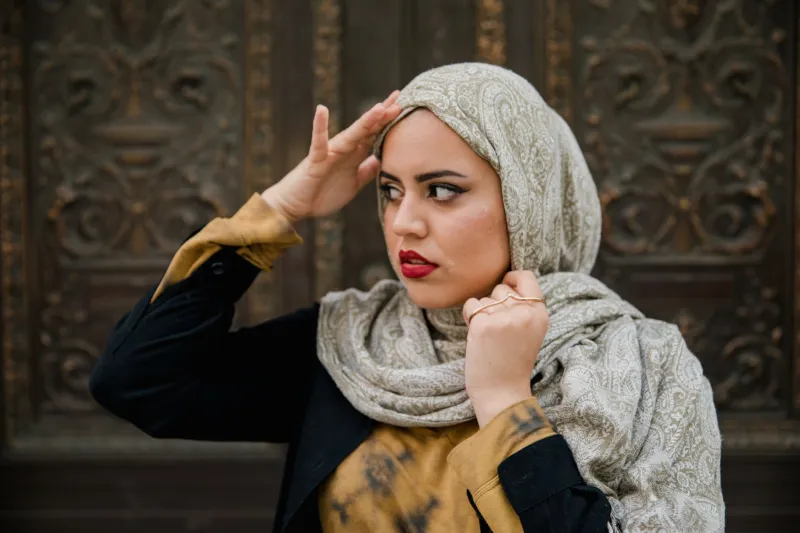
There is a particular kind of frustration that many American Muslim women know well: standing in front of a mirror in a beautifully constructed jilbaab, admiring the drape and the color, and then reaching for a bag only to realize there is nowhere to put a phone. Or stepping outside in August and understanding, within minutes, that the fabric chosen for its elegance was never designed with a humid Chicago summer in mind. Or sitting through a six-hour workday and discovering that a silhouette flattering in stillness becomes restrictive in motion.
This is the comfort conversation — and it is reshaping modest fashion in America from the inside out.
When Aesthetics Are No Longer Enough
For decades, modest Islamic fashion was largely evaluated through a single lens: does it fulfill the requirements of coverage? While that question remains foundational, American Muslim women are increasingly adding a second, equally important measure: does it support the demands of daily life?
This shift is not a rejection of tradition. It is, in many ways, a deepening of it. The principle of ease is woven throughout Islamic thought, and women who have spent years navigating modest dress in a fast-paced American context are applying that principle directly to their wardrobes. A jilbaab that restricts movement during a commute, overheats during a school pickup, or requires constant adjustment during a meeting is not, in any practical sense, serving its wearer — regardless of how impeccably it was constructed.
The result is a growing demand for modest wear that is designed with function as a primary consideration rather than an afterthought.
The Details That Define Wearability
Ask American Muslim women what they actually want from a jilbaab, and the answers are specific. Deep, accessible pockets rank near the top of nearly every list — not decorative slits, but genuine pockets capable of holding a phone, keys, or a transit card without creating visible bulk. In a country where women routinely carry their daily essentials without a bag, pocket placement has become a genuine measure of design thoughtfulness.
Fabric choice follows closely. Women navigating the wide range of American climates — from the dry heat of Phoenix to the layered winters of Minneapolis — need textiles that respond to those environments. Breathable linens and moisture-wicking blends for warmer months, structured yet lightweight wools for winter, and fabrics that maintain their shape through repeated washing and wearing. The desire is not for luxury for its own sake, but for materials that perform reliably across the seasons of a real life.
Silhouette flexibility matters equally. A jilbaab that works beautifully for a formal occasion but becomes cumbersome during a school drop-off or a grocery run will inevitably stay in the closet. Women are gravitating toward cuts that move with the body — that allow for a full stride, for bending, for sitting cross-legged on a floor — without requiring constant readjustment or creating awkward volume.
Real Lives, Practical Choices
The stories behind this shift are as varied as the women living them. A physical therapist in Northern Virginia describes spending years in traditional pieces that looked precisely right but left her exhausted by midday — fabric that absorbed heat, sleeves that caught on equipment, a silhouette that simply was not designed for a clinical environment. Her eventual move toward structured, breathable modest wear was not a stylistic statement. It was a practical necessity.
A mother of four in suburban Houston describes the moment she realized her wardrobe was working against her. Chasing children in a full-length garment that bunched at the hem, she began to understand that modest fashion could either be a daily obstacle or a genuine tool. She began seeking out jilbaabs with narrower, tapered hems and elastic-free waistlines that moved with her rather than against her.
A graduate student in Boston, commuting by subway and cycling between libraries, coffee shops, and lecture halls, found that the pieces she had worn comfortably during summers abroad did not translate to the pace of her American academic life. She began building a collection around a few key principles: lightweight layering, secure closures, and fabrics that did not wrinkle under a coat or a backpack strap.
None of these women abandoned their commitment to modest dress. They refined it.
The Design Response
The modest fashion industry, at its most attentive, is listening. Designers and retailers who serve American Muslim women are increasingly incorporating functional elements into collections without sacrificing the elegance that has always defined the category. The conversation has moved from whether to include pockets to where and how deep. Fabric testing now considers performance across seasons and activities. Silhouettes are evaluated not only on the hanger but in motion.
This evolution reflects a broader truth about American Muslim women as consumers: they are sophisticated, they are specific, and they are not willing to accept discomfort as the price of modesty. The market that responds to those expectations — that treats comfort and coverage as complementary rather than competing values — is the market that earns lasting loyalty.
Redefining What 'Works'
There is something quietly powerful about a woman who refuses to separate how she looks from how she feels. The comfort conversation is, at its core, a conversation about self-respect — about the understanding that a garment should serve its wearer in every dimension, not just the visible one.
For American Muslim women, this means modest fashion that travels with them through a full day: the morning commute, the professional meeting, the school pickup, the evening errand. It means clothing that does not require a mental checklist of adjustments every time they stand up or sit down. It means, in the simplest terms, wearing something that allows them to be fully present in their lives.
The jilbaab has always been more than a garment. For the women redefining it on American terms, it is becoming something even more specific: a piece of clothing that is as capable as they are.