Openings, Lengths, and Independence: An Accessible Dressing Guide for Muslim Women With Disabilities
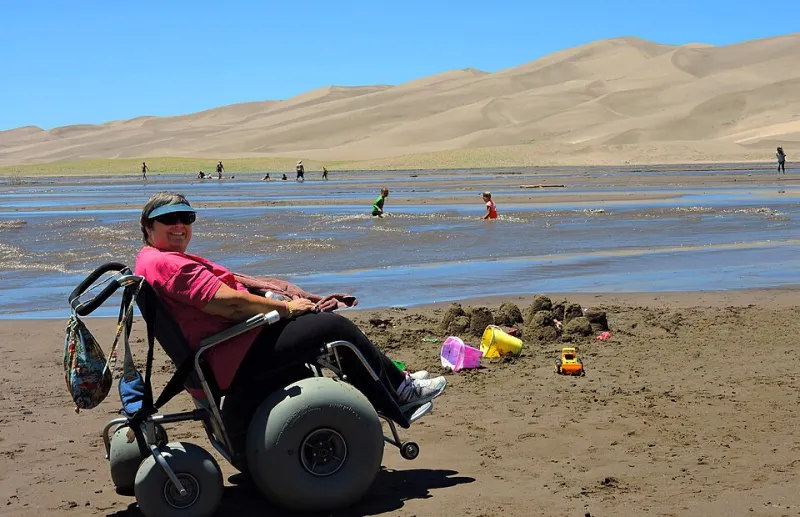
Photo: Great Sand Dunes National Park and Preserve, Public domain, via Wikimedia Commons
Modest fashion has spent several years proving that it belongs in the mainstream of American retail. It has spent far less energy on a question a meaningful share of its customers confront every morning: how does this garment go on over a body that does not move the way pattern cutters assume?
For Muslim women with disabilities — wheelchair users, women with limited hand strength or range of motion, women managing chronic pain, fatigue, or sensory sensitivity — the answer is often a tailor, a workaround, or a quiet compromise. Adaptive design remains a small corner of the modest market, and most of what exists was developed for older adults rather than for women in their twenties and thirties who want to dress with the same care as anyone else. The gap is not a matter of taste. It is a matter of construction.
What adaptive actually means in a modest context
Adaptive clothing is not a separate aesthetic. It is a set of construction decisions applied to an ordinary silhouette: where a closure sits, how much shoulder rotation it demands, how heavy the fabric is, how seams are finished, how the hem behaves when the wearer is seated, and how easily the garment can be altered again later. None of this is exotic. Almost all of it can be specified before a garment is cut, and the rest can be added afterward by someone with a sewing machine and clear instructions.
Closures that work for hands and shoulders
A front-opening coat style generally requires less overhead reach than a pullover, which is why so many adaptive modest designs begin there. Within that shape, the closure is the critical variable. Magnetic plackets close with a single gesture and suit women with limited grip. Hook-and-loop tape concealed beneath a decorative flap is inexpensive, quiet, and easy for a tailor to install. Large-format snaps work for some hands and defeat others. Zippers become far more usable with a ring pull or a long fabric tab attached to the slider, and elasticated cuffs replace buttons that small fingers cannot manage. It is worth noting that women with implanted cardiac devices should confirm magnetic closures with their clinician before buying.
Dressing from a seated position
Back-opening and side-opening designs let a woman dress without standing, and wrap styles with generous overlap achieve the same result with less hardware. Cap sleeves and drop shoulders reduce the reach required at the shoulder joint. Measurements should be taken while seated, not standing; a garment that drapes well upright can bunch across the lap and pull at the knee once the wearer sits, and the difference is often two to three inches. Dressing aids such as long-handled hooks and reachers extend what a single garment can do, but they cannot compensate for a placket that closes behind the shoulder blade.
Fabric that the body can tolerate
For women with sensory sensitivities or chronic pain, the inside of a garment matters as much as the outside. Tagless necklines, flat-felled or bound seams, and a smooth lining at the shoulder remove the scratch that makes an otherwise beautiful jilbaab unwearable. Chiffon at the neck and face is a frequent complaint, as are decorative trims that stiffen the front edge. Temperature regulation is another consideration: some women run cold and need weight, others overheat easily and need breathability, and a modest wardrobe for a body with fluctuating needs should plan for both rather than assume one.
Length, wheels, and hem safety
A hem should clear the floor when the wearer is seated and stay clear of wheels, footrests, and brake levers. Many wheelchair users prefer a length ending a few inches above the ankle, or an adjustable hem with an internal elastic casing that can be drawn up on wet days. Trailing fabric near a wheel is not merely an inconvenience; it is a genuine hazard on ramps and in transport. Test any new length in your own chair, on your own route, before the tags come off.
Briefing a tailor
Bring measurements taken while seated, and bring the chair itself if the shop can accommodate it. Ask for a fitting in the chair rather than standing at a mirror. Specify the closure you want and ask to handle a sample before the work begins. Request that seams be finished flat where they will contact skin. Ask for a quote before the work starts, photograph the finished modification for future orders, and keep the tailor's notes with the garment. Good alterations are a collaboration, and the second one is always easier than the first.
Questions to ask before buying
What is the return policy on a garment that has been tried on? What kind of closure does the placket use, and is there a short video showing it in operation? Are seams finished or overlocked? Does the brand offer modifications, or will the piece need a tailor? Can the placket be altered without unpicking the entire front? Is the fabric opaque at the shoulder in daylight? A brand that answers these questions readily is usually a brand worth returning to.
Independence as the measure
The right garment shortens dressing time, reduces the need to ask for help, and restores a private morning routine. That is the standard by which adaptive design should be judged — not how the piece photographs, not whether it resembles the season's editorial, but whether a woman can put it on by herself and leave the house on time. Dignity is not a decorative addition to modest fashion. It is the reason the category exists, and it belongs to every woman who wears it.