Stitching a New Economy: How Muslim Women Entrepreneurs Are Building Modest Fashion Empires From the Ground Up
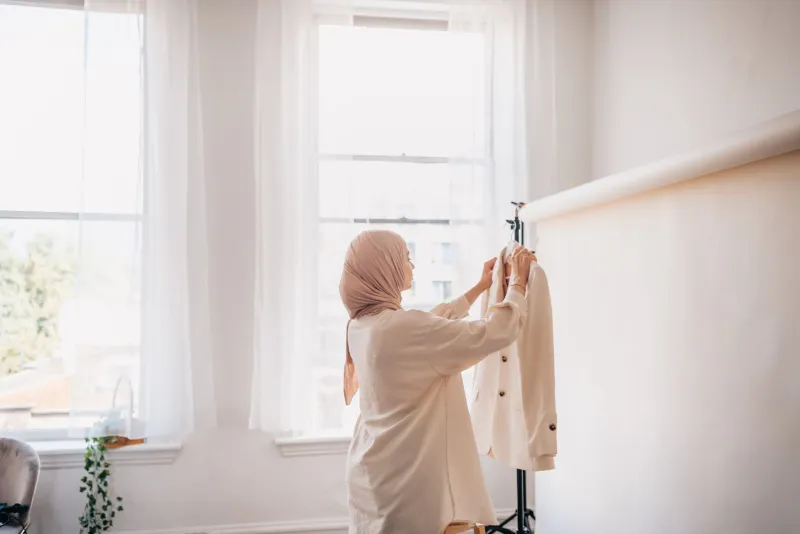
For much of fashion's modern history, modest dressing was treated as an afterthought — a subcategory that mainstream brands occasionally acknowledged with a capsule collection or a single campaign. That era is ending. Across cities like New York, Chicago, Houston, and Los Angeles, a rising class of Muslim women entrepreneurs is building fashion labels that do not simply cater to modest dressers — they are architected around them. These founders are not waiting for legacy brands to get it right. They are doing it themselves, and they are doing it at scale.
From Gap in the Market to Generational Opportunity
The numbers have long supported the case for investment in modest fashion. Global Muslim consumer spending on clothing and footwear has been estimated in the hundreds of billions of dollars annually, with American Muslim consumers representing a significant and underserved slice of that market. Yet for years, the industry's response was limited — ill-fitting hijab-friendly collections launched without cultural consultation, or fleeting trend pieces that treated modesty as a novelty rather than a lifestyle.
Muslim women entrepreneurs recognized what analysts were slow to quantify: that the demand was not merely for covered clothing, but for covered clothing that was beautiful, functional, seasonally appropriate, and designed by people who actually wore it. This insider perspective became the founding logic of a new wave of American modest fashion labels.
Brands built by Muslim women founders often begin from a place of personal frustration. A designer in Houston who could not find a jilbaab suitable for a professional setting. A mother in New Jersey who wanted her daughter dressed modestly for a school event without sacrificing elegance. A college student in Michigan who could not reconcile her love of contemporary aesthetics with the limited options available to her. These individual pain points became the blueprints for businesses.
Building Brands Without a Blueprint
Launching a fashion label is challenging under any circumstances. For Muslim women entrepreneurs, the obstacles carry additional dimensions. Access to traditional venture capital has historically been limited for founders who are women, founders who are minorities, and founders who operate in markets that mainstream investors do not fully understand. Muslim women founders often navigate all three of these challenges simultaneously.
Many have responded by developing alternative funding models. Community-based investment, where early customers become stakeholders through pre-order campaigns or crowdfunding platforms, has proven particularly effective. Others have leaned into halal financing structures that avoid interest-bearing loans, working instead with ethical lending institutions or reinvesting revenue carefully to fund growth organically. These approaches require patience, but they also cultivate a different kind of loyalty — customers who feel genuinely invested in a brand's success because, in many cases, they literally are.
Mentorship networks have also played a critical role. Organizations connecting Muslim women in business have grown considerably over the past decade, providing access to legal guidance, marketing expertise, and the kind of peer counsel that can mean the difference between a promising idea and a viable enterprise. These networks function as informal incubators, and their influence on the modest fashion sector has been considerable.
Designing With Authority
What distinguishes Muslim-owned modest fashion brands from their mainstream counterparts is not simply representation — it is expertise. When a designer who wears a jilbaab daily creates a jilbaab, she brings a knowledge of fit, movement, and practicality that cannot be replicated through market research alone. She knows which fabrics hold their shape through a long workday, which sleeve lengths allow for ease of movement without appearing untidy, and which silhouettes translate gracefully from a morning meeting to an evening gathering.
This embedded knowledge produces garments of a different quality. It shows in the details: reinforced seams at points of frequent stress, thoughtful color palettes developed with layering in mind, and sizing that accounts for the full range of body types within Muslim communities. It also shapes the brand voice — the way products are described, the imagery used to present them, and the values communicated through every customer interaction.
For consumers who have spent years feeling unseen by the fashion industry, this difference is profound. It translates directly into brand loyalty, word-of-mouth growth, and communities of customers who advocate passionately for the labels that finally got it right.
Economic Power Within the Community
The impact of Muslim-owned modest fashion brands extends well beyond the founders themselves. These businesses create employment within Muslim communities — designers, seamstresses, logistics coordinators, customer service representatives, and social media managers who share the cultural context of the brand and bring authentic understanding to their roles.
Many of these brands also source consciously, prioritizing suppliers who align with their ethical commitments. Halal supply chains, fair labor practices, and sustainable material sourcing are not marketing add-ons for these founders — they are core values that shape every procurement decision. In this way, the economic activity generated by a single modest fashion brand can ripple outward through multiple layers of the community.
Retail footprints are expanding as well. While many Muslim-owned modest fashion brands launched as direct-to-consumer online operations — a practical choice given lower overhead and direct access to a digitally connected customer base — a growing number are establishing physical presences. Pop-up shops during Ramadan and Eid seasons have given way to permanent boutiques in cities with substantial Muslim populations, creating physical gathering points that strengthen community bonds alongside commercial ones.
Setting a New Standard for the Industry
Perhaps the most consequential contribution of Muslim women entrepreneurs in modest fashion is the standard they are setting for the industry as a whole. As their brands grow in visibility and revenue, they demonstrate to mainstream fashion that modest dressing is not a temporary trend or a charitable cause — it is a permanent, sophisticated, and economically significant market.
This visibility is beginning to shift behavior upstream. Buyers at major department stores are taking modest fashion more seriously. Fashion weeks are featuring more modest collections. Mainstream publications are covering modest style with greater depth and regularity. While much of this attention remains imperfect, the underlying pressure driving it comes, in no small part, from the success of the entrepreneurs who refused to wait.
For the American Muslim woman who has long sought clothing that honors her faith without compromising her sense of style, the rise of these brands is more than a commercial development. It is a cultural affirmation — evidence that her aesthetic, her values, and her purchasing power are worthy of serious creative investment. And for the founders building these businesses, it is the fulfillment of something that was always true: that the most compelling fashion stories are written by the people who live them.