Dressed With Intention: How Choosing a Jilbaab Over Fast Fashion Is Quietly Improving Mental Health
There is a particular kind of exhaustion that comes with modern fashion consumption. The relentless churn of micro-trends, the inbox flooded with flash sales, the closet bursting with pieces that somehow never feel quite right — for many American women, this cycle has become a source of low-grade, persistent stress. For a growing number of Muslim women in the United States, however, a deliberate departure from that cycle — anchored in the practice of modest dressing and the considered selection of jilbaabs and traditional garments — is offering something the fast fashion industry never could: genuine peace of mind.
This is not a wellness trend packaged and sold back to consumers. It is something quieter, more personal, and increasingly well-documented in the lived experiences of Muslim women who have made intentionality the cornerstone of how they dress.
The Fast Fashion Trap and Its Psychological Toll
Fast fashion operates on a simple psychological principle: create desire, manufacture urgency, and repeat. Retailers release dozens of micro-collections each year, algorithmically targeted advertising tracks consumers across platforms, and the message is consistent — what you own is already out of style. For women navigating this landscape, the result is often a wardrobe full of impulse purchases and a persistent, nagging sense of inadequacy.
Research in consumer psychology has long established a connection between compulsive or trend-driven shopping and elevated levels of anxiety and diminished self-worth. When a woman's relationship with clothing is defined primarily by external validation — whether she is current, whether she looks the part, whether she is keeping pace — the foundation of her self-image becomes inherently unstable. The next trend will always arrive. The goalposts will always move.
For many American Muslim women, the framework of modest fashion — and specifically the jilbaab as a garment of both spiritual and personal significance — offers a fundamentally different relationship with clothing altogether.
Intentionality as a Form of Self-Care
When a woman chooses a jilbaab, the decision is rarely impulsive. It involves consideration of fabric, fit, occasion, and how a piece integrates with what she already owns. This deliberate approach to dressing, repeated across every addition to a modest wardrobe, cultivates a habit of mind that is essentially the opposite of fast fashion consumption.
Psychologists who study decision-making have observed that when people narrow their choices and align their purchases with clearly held values, they experience less post-purchase regret and greater overall satisfaction. For Muslim women whose dressing is guided by the principles of modesty, this alignment between belief and behavior is built into the act of getting dressed every morning. The jilbaab is not a trend to be chased. It is a reflection of something enduring.
Many women describe this shift in terms that mirror what mindfulness practitioners call "intentional living" — a conscious engagement with daily choices rather than a passive response to external pressures. When the question is not "What is fashionable this season?" but rather "What serves me, reflects my values, and will last?" the entire emotional tenor of shopping and dressing changes.
A Wardrobe That Knows Itself
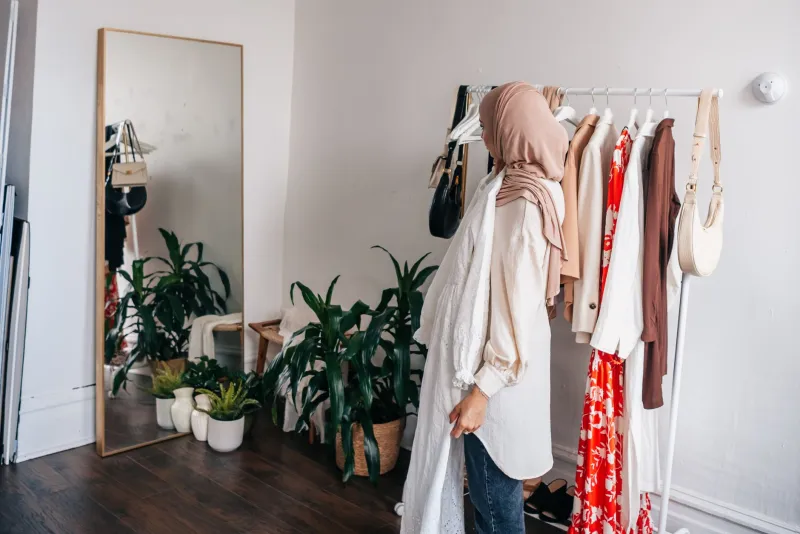
One of the most frequently cited benefits among Muslim women who have transitioned away from trend-driven consumption is the relief of a coherent wardrobe. When every piece in a closet has been chosen with care — when jilbaabs, modest separates, and layering pieces all belong to a considered aesthetic — getting dressed ceases to be a source of morning anxiety and becomes, instead, a quiet ritual of self-expression.
This coherence has measurable psychological benefits. Studies on what researchers call "decision fatigue" suggest that the more trivial choices a person makes throughout the day, the more depleted their cognitive and emotional resources become. A wardrobe built around a clear modest aesthetic — anchored by versatile, well-made jilbaabs rather than a rotating carousel of impulse purchases — reduces the number of decisions required each morning and preserves mental energy for what actually matters.
For American Muslim women managing demanding careers, active family lives, and complex social identities, this is not a small thing. It is a meaningful reclamation of cognitive bandwidth.
Identity, Stability, and the Jilbaab
There is another dimension to this conversation that goes deeper than wardrobe logistics. For Muslim women in the United States, dressing modestly is an act of identity affirmation in a cultural environment that does not always make that easy. The decision to wear a jilbaab, particularly in professional or public settings, is rarely passive. It is a statement — to oneself as much as to the world — about who one is and what one values.
Psychologists who study identity and well-being consistently find that clarity about one's values and a strong sense of personal identity are among the most reliable predictors of psychological resilience. When a woman's clothing is an authentic expression of her beliefs rather than a performance of external expectations, it reinforces rather than undermines her sense of self.
This is especially significant in the American context, where Muslim women often navigate competing cultural narratives about what their dress means. Choosing intentional modest fashion — selecting a beautifully crafted jilbaab because it reflects genuine conviction, not because it has been sanctioned by a trend cycle — is an act of self-determination. And self-determination, research consistently shows, is good for mental health.
Quality Over Volume: A Different Kind of Abundance
The fast fashion model equates abundance with volume — more pieces, more options, more newness. The modest fashion philosophy, at its best, proposes a different kind of abundance: depth over breadth, quality over quantity, meaning over novelty.
For many American Muslim women, investing in fewer, better jilbaabs and modest pieces — garments that are well-constructed, thoughtfully designed, and genuinely aligned with how they live — has produced a sense of sufficiency that fast fashion, by design, never delivers. There is a particular satisfaction in owning something that does not need to be replaced, that ages gracefully, that continues to serve its purpose season after season.
This satisfaction is not merely aesthetic. It is psychological. It is the experience of having enough — and knowing it.
A Quiet Counter-Culture
In a fashion industry that profits from manufactured insecurity, the choice to dress with intention is, in its own understated way, a radical act. American Muslim women who have built their wardrobes around jilbaabs and modest pieces chosen for their quality, versatility, and alignment with personal values are not simply making different purchasing decisions. They are opting out of a system designed to keep them perpetually dissatisfied.
The mental health benefits they report — reduced anxiety, stronger self-image, greater daily ease, a more settled sense of identity — are not incidental. They are the natural consequence of dressing from the inside out rather than the outside in.
In a culture that rarely pauses to ask whether more is actually better, that is a perspective worth wearing with pride.