What You Wear Before You Speak: The Quiet Power of the Jilbaab in American Professional Spaces
There is a well-documented principle in social psychology that human beings form lasting impressions within seconds of meeting someone new. Researchers at Princeton University have suggested that judgments about competence, trustworthiness, and likability are made in as little as one-tenth of a second — long before any credentials are presented or words are spoken. For Muslim women who choose to wear the jilbaab, this reality is not abstract. It is lived, navigated, and — increasingly — reframed on their own terms.
The American workplace has never been a neutral space. Its dress codes, whether written or implied, have historically reflected the values and aesthetics of a dominant culture. For Muslim women, entering that space in a jilbaab means arriving with a visible declaration of faith and identity that some employers and colleagues may not have encountered before. What happens in those early moments — and how women navigate them — reveals something important about the intersection of perception, professionalism, and personal conviction.
The Psychology of Visible Difference
Research on appearance-based bias in hiring and professional settings is extensive and, at times, sobering. Studies published in journals including the Journal of Applied Social Psychology have documented that candidates whose appearance signals religious or cultural difference can face measurable disadvantage in certain hiring contexts. This is not a reflection of the candidates' qualifications but rather of the implicit associations that evaluators bring to the table.
For Muslim women in particular, the jilbaab can trigger what researchers describe as "categorization" — a cognitive shortcut through which an observer assigns a person to a social group before processing individual attributes. When that categorization is accompanied by unfamiliarity or cultural misunderstanding, it can translate into hesitation, skepticism, or, in more explicit cases, discrimination.
Yet the picture is more nuanced than a straightforward narrative of bias would suggest. Several studies have also found that visible markers of religious observance can, in certain professional contexts, signal discipline, integrity, and consistency — qualities that are highly valued across industries. The same visibility that invites scrutiny can also invite respect, depending on the environment, the observer, and the manner in which a woman carries herself.
What Muslim Women Professionals Say
Conversations with Muslim women working across American industries — from finance and law to healthcare and education — reveal a shared awareness of the dynamics at play, alongside a remarkable degree of strategic clarity.
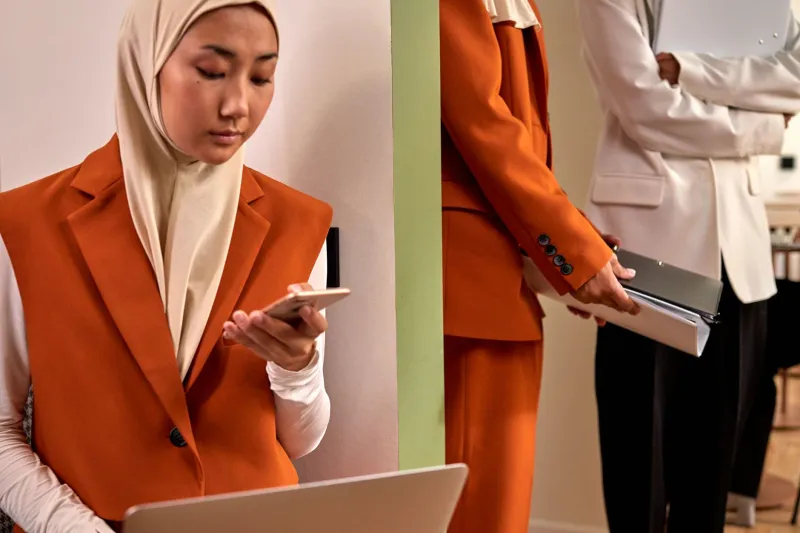
Many describe a deliberate attention to the quality, structure, and presentation of their jilbaab in professional settings. A well-tailored, composed garment communicates intentionality. It signals that the wearer has made a considered choice — not a default or an imposition — and that she brings the same level of care to her professional responsibilities. Several women note that colleagues who initially expressed uncertainty have, over time, come to associate their modest dress with reliability and focus.
Others speak candidly about the additional labor involved. Preparing for a job interview often means not only researching the company and rehearsing answers but also anticipating how one's appearance will be received and calibrating accordingly. This is a form of emotional and cognitive work that their peers without visible religious markers rarely need to perform. Acknowledging this reality — without allowing it to diminish confidence — is itself a professional skill that many Muslim women have cultivated with considerable sophistication.
Modest Dress as Strategic Asset
For women who have navigated American workplaces for years in a jilbaab, a recurring insight emerges: modest fashion, when approached thoughtfully, functions as a form of personal branding. It is consistent, distinctive, and memorable. In a professional landscape where differentiation is often an asset, being recognizable — and recognized as someone whose values are visible and coherent — can work in a woman's favor.
This is not to suggest that the jilbaab should be treated primarily as a career tool. Its significance is, first and foremost, spiritual and personal. But there is no contradiction in recognizing that something worn as an expression of faith can also communicate professionalism, confidence, and authority. The women who navigate this most effectively tend to be those who have internalized both dimensions — who wear the jilbaab not despite their ambitions but as an integrated expression of who they are.
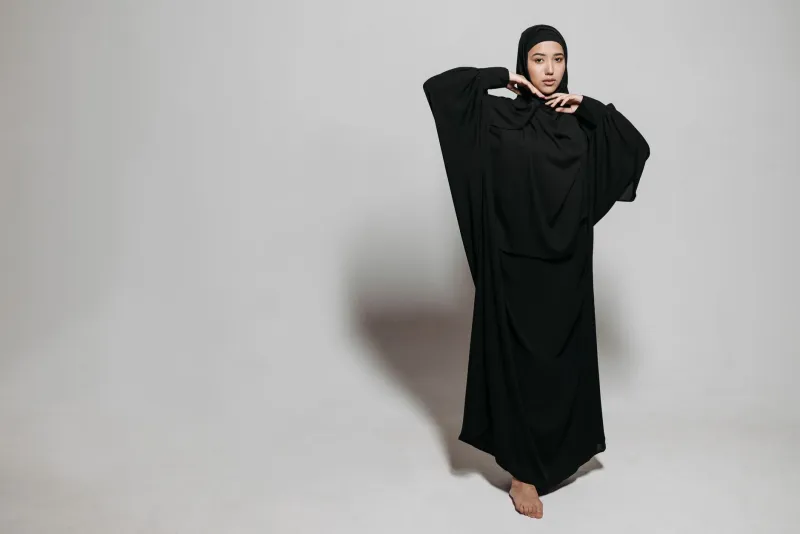
Practical considerations matter here. Fabric choice, color palette, and silhouette all contribute to the professional impression a jilbaab makes. Structured fabrics such as crepe or ponte knit tend to read as more formal than flowing chiffon in many corporate environments. Neutral and deep tones — navy, charcoal, forest green, burgundy — often align with the visual language of American professional dress without requiring any compromise of modesty or personal aesthetic. These are not concessions; they are choices, made from a position of knowledge and agency.
Navigating Unspoken Expectations
Every American workplace has an unofficial dress culture that exists alongside — and sometimes in tension with — its formal policies. Understanding that culture, and determining how to engage with it authentically, is a task that Muslim women undertake with particular deliberateness.
In some environments, modest fashion is genuinely welcomed. Diversity, equity, and inclusion initiatives at many major corporations have created more conscious awareness of religious accommodation, and HR departments in well-resourced organizations are often prepared to support Muslim employees in ways that were less common a generation ago. In other settings, the culture is less evolved, and women must decide how much energy to invest in education versus how much to simply demonstrate competence and allow their work to speak.
What remains consistent across these varied environments is the importance of entering any professional space with composure and clarity. Women who project confidence in their choices — who do not arrive apologetically or with visible anxiety about how they will be perceived — tend to set a tone that others follow. First impressions are shaped not only by what is worn but by how it is worn.
A Shifting Landscape
It would be inaccurate to describe the American professional world as uniformly welcoming of visible religious identity. Discrimination remains a documented reality, and the legal protections offered by Title VII of the Civil Rights Act, while meaningful, are not always sufficient to prevent bias from shaping decisions.
And yet the landscape is shifting. The growing visibility of Muslim women in American public life — in government, in media, in business leadership — has gradually expanded the cultural imagination of what professional success looks like. Each woman who appears in a jilbaab at a conference table, a courtroom, or a commencement stage contributes to a broader redefinition of professional presence.
The jilbaab, in this sense, does more than shape individual first impressions. Worn with intention and worn well, it participates in a longer conversation about who belongs in American professional spaces — and on what terms.