The Circle Beyond the Screen: How American Muslim Women Are Building Real Communities Around Modest Fashion
Photo: Chris.sherlock2, CC BY-SA 4.0, via Wikimedia Commons
When the Feed Is Not Enough
There is a particular kind of loneliness that can accompany scrolling. You see beautiful images, read encouraging captions, and tap the heart button—and yet something remains unsatisfied. For many American Muslim women navigating modest fashion in a culture that rarely centers their experience, the gap between digital inspiration and lived reality can feel wide.
Social media has undeniably expanded the visibility of modest fashion. Creators across Instagram, TikTok, and YouTube have introduced millions of women to new styling approaches, fabric combinations, and cultural interpretations of modest dress. That contribution is real and should not be minimized.
But visibility is not the same as community. And community, it turns out, is what many women are actively seeking—and increasingly finding—in the physical world.
The Rise of the Styling Circle
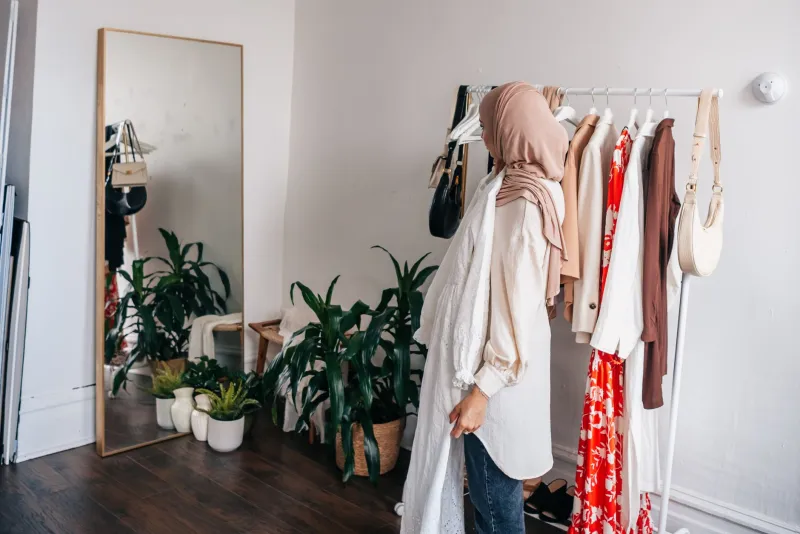
In cities and suburbs across the country, a quiet but meaningful movement has taken shape. Women are organizing modest fashion styling circles: small, informal gatherings where attendees bring garments from their own wardrobes, share styling techniques, and offer one another honest feedback in a space defined by mutual respect and shared values.
These circles take many forms. Some are organized through local mosques or Islamic centers and meet monthly. Others emerge from friendship groups who discovered a shared interest and decided to formalize it. A few have grown into structured events with guest speakers—seamstresses, fabric experts, or experienced modest fashion shoppers—who share knowledge that would take years to accumulate independently.
What unites them is the quality of exchange they make possible. In a styling circle, a woman can hold a garment up to the light and ask, honestly, whether the fabric is too sheer for outdoor wear. She can try on a friend's jilbaab and receive genuine feedback about fit and proportion. She can hear how another woman navigated a job interview in full modest dress, or how someone else found a reliable tailor in the neighborhood who understands her specific needs.
This kind of knowledge is not easily transmitted through a screen. It lives in conversation, in gesture, in the particular kind of trust that develops between women who share a room.
The Garment Swap as Cultural Practice
One of the most distinctive expressions of these communities is the modest fashion swap event—a gathering where women bring gently worn garments they no longer use and exchange them with others in attendance.
The swap serves multiple purposes simultaneously. It is, on a practical level, an economical way to refresh a wardrobe without spending significantly. For women building a modest wardrobe on a careful budget, the ability to acquire quality pieces through exchange rather than purchase can be genuinely meaningful.
But the swap is also something more than a transaction. It is an act of communal generosity, a recognition that the garments we have loved and worn carry something of us in them—and that passing them forward to someone who will wear them with the same care is a form of connection across households and, sometimes, across generations.
In several communities, swap events have become anchored occasions in the social calendar. Women plan for them weeks in advance, curating what they will bring, considering who might appreciate a particular piece. The events themselves often extend well beyond the exchange, becoming afternoons of shared food, conversation, and the particular ease that comes from being among people who understand your life without extensive explanation.
Local Boutiques as Community Anchors
Physical retail spaces have also emerged as important gathering points for modest fashion communities. Independent boutiques that specialize in modest wear are, at their best, more than stores—they are places where women can ask questions without judgment, try garments in a space designed for their needs, and encounter others who share their values.
Some boutique owners have leaned into this role deliberately, hosting styling events, fabric consultations, and seasonal preview gatherings that transform the retail experience into something more relational. The result is a customer relationship that runs deeper than any loyalty program could manufacture.
For women in smaller cities or suburban areas where modest fashion options are limited, these boutiques—and their online counterparts—become especially significant. They represent not just a shopping resource but a point of cultural affirmation: evidence that their needs are understood and their aesthetic preferences are worth serving with care and expertise.
What These Communities Actually Offer
It would be easy to frame these gathering spaces primarily in terms of fashion—as though the garments were the point. But the women who participate in styling circles and swap events and boutique gatherings tend to describe something richer than shared wardrobe enthusiasm.
They describe confidence. The particular kind of confidence that comes from being surrounded by women who have navigated the same social terrain—who have fielded the same workplace questions, managed the same family dynamics, and found their own ways to dress with intention in a culture that does not always make that easy.
They describe mentorship, often informal and unannounced. An older woman who has worn modest dress for decades carries knowledge that no online tutorial can fully replicate. She knows which fabrics hold up through years of wear. She knows how to speak about her choices with grace and without defensiveness. She knows, in the most practical sense, how to be herself in America—and she is willing to share that knowledge with women who are still finding their way.
They describe friendship—the straightforward, sustaining kind that is increasingly difficult to build in adult life and that these communities, built around shared values and genuine mutual interest, seem to generate with relative ease.
Building Your Own Circle
For women interested in cultivating this kind of community, the starting point is almost always simpler than it seems. A styling circle can begin with three friends and a living room. A swap event can be announced through a mosque newsletter or a neighborhood group chat. A relationship with a local boutique can start with a single honest conversation about what you are looking for and what you have not been able to find.
The infrastructure is less important than the intention. What these communities share is not a particular format but a willingness to prioritize genuine connection—to invest time and presence in relationships that social media can inspire but never, on its own, fully provide.
The jilbaab, at its most meaningful, is not merely a garment. It is an expression of identity, a statement of values, and a thread connecting women to one another across time and geography. The communities forming around it in living rooms and boutiques and community centers across the United States are honoring that meaning in the most direct way possible: by showing up, in person, for one another.