Spend Wisely, Dress Beautifully: A Practical Approach to Building a Jilbaab Wardrobe on Any Budget
There is a particular kind of pressure that comes with building a modest wardrobe in America. On one side sits the desire to dress with intention — to choose pieces that honor personal values, reflect cultural identity, and present a polished image in professional and social settings. On the other sits the reality of a household budget, student loans, rising costs of living, and the endless churn of seasonal fashion that can make even the most disciplined shopper feel perpetually behind.
The good news is that a thoughtful jilbaab wardrobe does not require a lavish spending plan. It requires something more valuable: a clear strategy.
Start With an Honest Wardrobe Audit
Before purchasing a single new piece, take stock of what you already own. Lay out every jilbaab, abaya, modest dress, and layering piece you currently have access to. Ask yourself which items you reach for consistently, which ones hang untouched for months, and which gaps in your wardrobe cause genuine inconvenience — the missing neutral-toned piece for work, the lightweight option that would carry you through summer, the formal option you have been borrowing from a friend.
This exercise accomplishes two things simultaneously. It prevents duplicate purchases — one of the most common ways modest fashion budgets erode quietly over time — and it gives you a precise shopping list rather than a vague intention to "find more jilbaabs." Specificity is the foundation of smart wardrobe spending.
Understand the Investment Piece Framework
Not every item in your wardrobe deserves the same level of financial commitment. The key to stretching a modest fashion budget is understanding which pieces earn a higher price point and which do not.
Investment pieces are those you wear with high frequency, in multiple contexts, and across multiple seasons. A well-constructed, neutral-colored jilbaab in a breathable, durable fabric — think a mid-weight crepe or a quality cotton blend — falls squarely into this category. Worn three times a week for two years, even a $120 jilbaab breaks down to mere cents per wear. In this light, the cost becomes far more reasonable.
Trend-adjacent pieces, by contrast, are those driven by seasonal color palettes, passing silhouette preferences, or occasion-specific styling. These are the items where budget-consciousness pays off most clearly. A modestly priced jilbaab in a fashionable color for the season, purchased at a lower price point, serves its purpose beautifully without requiring a significant financial commitment.
The practical rule: spend more where you wear more, and spend less where you wear less often.
Build Around a Core Color Palette
One of the quietest forms of financial discipline in modest fashion is committing to a cohesive color palette. When every piece in your wardrobe works harmoniously with every other piece, the number of outfits you can assemble multiplies without any additional spending.
For American Muslim women navigating both professional environments and community occasions, a palette anchored in deep neutrals — charcoal, navy, camel, ivory — provides the widest range of versatility. Seasonal accents in muted earth tones or soft pastels can be introduced through more affordable pieces, keeping the wardrobe feeling current without disrupting its foundational coherence.
A wardrobe of twelve carefully chosen, coordinating pieces will serve you more effectively — and more economically — than a closet of thirty items that resist mixing and matching.
Timing Your Purchases Strategically
The American retail calendar offers consistent opportunities for significant savings, and modest fashion shoppers who learn to work with these rhythms rather than against them can extend their budgets considerably.
End-of-season sales — typically occurring in late January and again in late July — often reduce core pieces by thirty to fifty percent. Purchasing a quality winter-weight jilbaab at the close of the cold season, with the intention of wearing it the following year, is a straightforward way to access higher-quality pieces at accessible prices.
Major retail moments such as Eid al-Fitr and Eid al-Adha also prompt many modest fashion retailers to offer promotions, making them natural windows for planned purchases. Similarly, Ramadan often brings curated collections and occasional discounts from specialty retailers catering to the Muslim community.
Patience, in this context, is a purchasing strategy.
Explore the Full Landscape of Modest Fashion Retail
The American modest fashion market has expanded considerably in recent years, and the range of price points available to consumers reflects that growth. Specialty online boutiques — including those focused specifically on jilbaabs and modest wear — frequently offer competitive pricing alongside curated selections that general retailers cannot match in terms of coverage standards and aesthetic coherence.
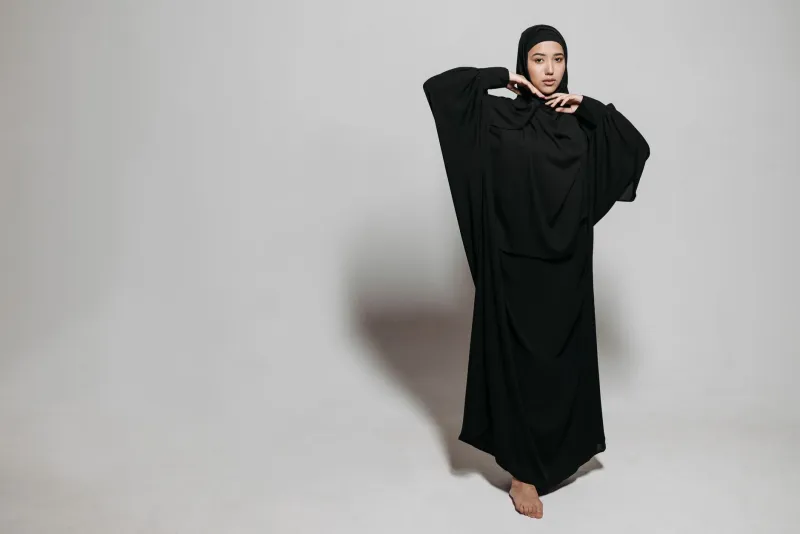
Beyond dedicated modest fashion retailers, mainstream American brands have increasingly introduced lines and individual pieces that align with modest dressing principles. Learning to identify these options — longer hemlines, full-coverage sleeves, relaxed silhouettes in quality fabrics — opens additional budget-friendly avenues without requiring compromise on standards.
Secondhand and resale platforms have also matured significantly. Community-based resale groups, particularly those organized within local Muslim women's networks or through national online communities, can be excellent sources for gently worn, high-quality pieces at a fraction of their original cost.
Care as a Financial Strategy
The lifespan of a jilbaab is as much a function of how it is maintained as it is of its original construction quality. Proper garment care — following fabric-specific washing instructions, air-drying rather than machine-drying where appropriate, storing pieces folded or hung correctly — extends the functional life of every item in your wardrobe.
A $90 jilbaab that lasts four years represents better value than a $60 piece that deteriorates after eighteen months of careless laundering. Viewed through this lens, the time invested in proper garment care is a direct financial return.
Minor repairs — replacing a button, re-stitching a seam, addressing a small tear before it widens — are similarly worth the small effort they require. These interventions preserve pieces that might otherwise be prematurely retired.
The Wardrobe as a Reflection of Values
There is something deeply consistent between the principles of modest dressing and the principles of thoughtful spending. Both practices ask for intentionality over impulse, quality over quantity, and a long view over the immediate gratification of a trend.
Building a jilbaab wardrobe on a considered budget is not a compromise — it is an expression of the same values that make modest fashion meaningful in the first place. It is the understanding that what we choose to wear, and how we choose to acquire it, says something about who we are and what we believe.
With the right framework, a beautiful, functional, and financially sustainable modest wardrobe is not only achievable — it is well within reach.