When Fabric Speaks First: How the Jilbaab Opens Unexpected Doors in American Social Spaces
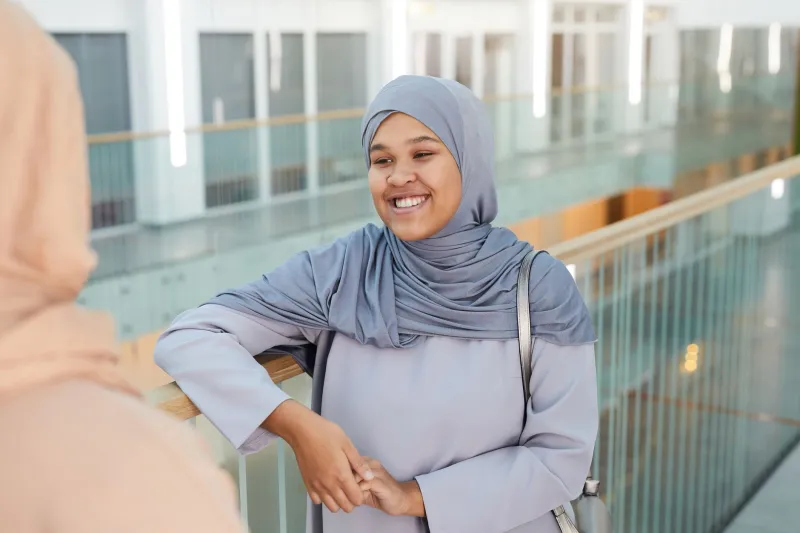
There is a particular moment that many American Muslim women recognize instinctively. It arrives at a cocktail networking event, a campus fashion showcase, or a neighborhood block party—the moment when someone's gaze lingers a second too long, followed by an earnest, if sometimes awkward, question. "That's beautiful. What is it called?" Or perhaps: "Is that a specific style, or something you designed yourself?"
These encounters are rarely confrontational. More often, they are the beginning of something unexpectedly meaningful.
The jilbaab—a full-length, modest outer garment worn by many Muslim women as an expression of faith and identity—has quietly become one of the most effective conversation-starters in contemporary American social life. Not because it seeks attention, but precisely because it is so visually distinct from the dominant aesthetic of American fashion that it naturally invites inquiry.
The Unplanned Teaching Moment
For Nadia, a marketing consultant based in Chicago, these moments happen regularly at professional networking events. "I wear a structured, tailored jilbaab in deep burgundy to most industry mixers," she explains. "Without fail, at least one person asks about it—sometimes a woman who is curious about the fabric, sometimes a man who genuinely doesn't know what he's looking at. Either way, I've found that it opens up a conversation that goes far deeper than most small talk at those events."
What begins as a question about fabric or silhouette often evolves into a broader discussion about identity, intentionality in dressing, and the relationship between faith and personal expression. These are not conversations most people expect to have at a chamber of commerce reception. Yet they happen regularly, and they tend to leave lasting impressions.
This phenomenon—what some within the American Muslim fashion community have begun calling the "jilbaab effect"—refers to the garment's quiet power to humanize modest wear in spaces where it is least expected. Rather than existing as a symbol to be debated from a distance, the jilbaab, when worn by a confident, engaged woman in an everyday American context, becomes something tangible, relatable, and worthy of genuine curiosity.
Navigating Curiosity With Confidence
Not every question is easy to answer, and not every encounter is immediately comfortable. American Muslim women who wear the jilbaab regularly navigate a spectrum of reactions—from warm admiration to poorly worded assumptions—and many have developed thoughtful, almost practiced, responses that educate without lecturing.
Amira, a graduate student in fashion design at a prominent New York arts school, describes her experience within a community that prides itself on avant-garde thinking. "Fashion students are curious and opinionated, which means the questions come fast and sometimes without much filter. I've been asked if I'm 'allowed' to wear color, or if my family 'makes' me dress this way. But those questions, as clunky as they are, give me an opening."
Her approach is deliberate: she answers the literal question first, then gently redirects toward the creative dimension of her choices. "I tell them that I chose this. That I spend as much time thinking about silhouette and drape as any designer in the room. That modesty isn't a limitation—it's a design constraint, and constraints are where interesting things happen." The result, she says, is that her peers leave the conversation with an entirely different understanding of what modest fashion represents.
The Fashion Community's Evolving Awareness
Within fashion-forward communities specifically, the jilbaab has begun to occupy an increasingly respected position. American fashion discourse, long dominated by a narrow aesthetic vocabulary, has been slowly—if unevenly—expanding to include modest wear as a legitimate design category rather than a niche accommodation.
This shift is visible in how conversations about modest fashion have moved from the margins to more central platforms. Style bloggers, editorial teams, and independent fashion collectives across cities like Los Angeles, Houston, and Detroit have begun engaging with modest wear not as an anthropological curiosity but as a design tradition with its own logic, history, and contemporary innovation.
For Muslim women navigating these spaces, the jilbaab often serves as a living artifact of that tradition. When Rania, a Houston-based stylist, attended a regional fashion week showcase, she wore a dramatic, floor-length jilbaab in silk crepe with architectural pleating at the shoulders. "Three designers came up to me afterward," she recalls. "Not to ask about my religion. To ask about the construction. They wanted to know how the pleating was achieved, where the piece was made. It was a purely technical conversation, and it was wonderful."
Reclaiming the Narrative in Casual Settings
Beyond professional and fashion contexts, some of the most transformative conversations happen in the most ordinary settings—grocery stores, school pickup lines, community fitness classes. These informal exchanges carry their own particular weight because they occur between neighbors, not professionals or creatives primed to engage with difference.
In these moments, American Muslim women often describe a sense of responsibility alongside the opportunity. The question "Why do you dress that way?" from a curious neighbor carries different stakes than the same question from a fellow designer student. It asks for something more personal, more fundamental.
Many women respond by grounding their answer in something universal: the desire to dress with intention. "I tell people that my jilbaab is how I show up as myself," says Fatima, a mother of three in suburban New Jersey. "It's not a barrier. It's a signature. And once people understand that, the whole conversation changes."
What the Jilbaab Teaches Without Trying
Perhaps the most significant aspect of the jilbaab effect is what it communicates without any words at all. Presence, confidence, and deliberate self-presentation are qualities that read across cultural lines. A woman who moves through a room comfortably in her modest dress—who engages, laughs, debates, and contributes—dismantles stereotypes more effectively than any formal explanation ever could.
The jilbaab, in this sense, is not merely a garment. It is a form of representation. Each appearance in a professional space, a creative community, or a casual neighborhood gathering is a small act of visibility that accumulates into something larger: a broader, more nuanced American understanding of who Muslim women are, what they value, and how they choose to engage with the world.
For the women who wear it daily, this is not a burden. It is, more often than not, simply part of the fabric of their lives—one conversation, one curious question, one shifted perception at a time.